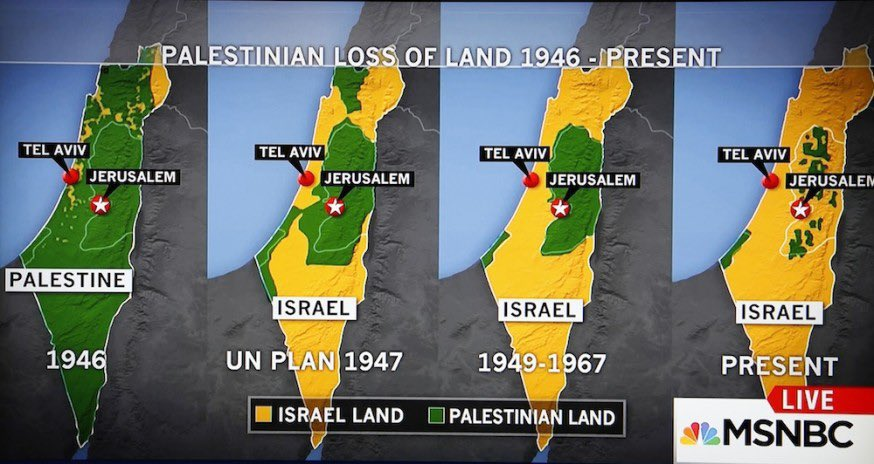
Where is condemnation for Gaza attack , phosphorus bomb, cut electricity and water for 2 million people of Gaza? What a crooked
— @IDF Israeli Diaper Force ( Parody ) (@fulsin1) October 11, 2023
Ursula von der Leyen— another NWO/ZOG drone. Completely in the pocket of Israel and the Jew-Zionist lobby.
Yocheved Lifshitz, an elderly Israeli hostage who was released by Hamas along with another woman on Monday, said she was beaten by militants while being taken to Gaza on October 7, but was treated well during her captivity.#HostageRelease#HamasTerrorists#Gazapic.twitter.com/i2LD4m8IKO
“...was treated well during her captivity“. Will the same be true of those captured by the Israelis? So far they have taken few prisoners anyway…
I seem to recall from my visit to Rhodesia in 1977 that the Rhodesian security forces also took relatively few prisoners.
hamas seems to care more about the israeli hostages than israel itself who are bombing the entire of gaza indiscriminately where hamas are supposed to be hiding with the hostages. https://t.co/KZcxSy7cA1
The Israeli/Jew-Zionist propaganda machine is having its fear propaganda questioned, and by the freed Jewish hostages themselves.
When asked what she meant by the gesture of shaking a Hamas gunman's hand, freed hostage Yocheved Lifshitz, 85, says 'because they treated us very nicely'.
"They seemed really prepared and had concealed it for a long time," she added.
Already some Jews are describing her as “a self-hating Jew“. Will they be pressing for her to be imprisoned in Israel now?
An 85-year-old woman freed by Hamas said Tuesday she was treated well during more than two weeks held captive in #Gaza. "They treated us well," Yocheved Lifshitz told the media at a Tel Aviv hospital a day after her release, explaining a doctor visited her and fellow hostages… pic.twitter.com/qFYig7kFci
Destroyed armored group of the Armed Forces of Ukraine consisting of Leopard 2A4 tanks, T-64BV and BTR-80 armored personnel carrier and another armored vehicle in the area of the village of Rabotino, Zaporizhia Front pic.twitter.com/ZsEHB2ODs5
An IDF ground operation in the Gaza Strip could take months, require significant military forces, and “the Israeli military is already stretched to the limit,” Vice reports , citing senior US officials and the Israeli military.
If that is true, i.e. that the Israeli forces are now stretched to the limit, then now, logically, would be the moment for Lebanon, Syria, Jordan, even Egypt, and those imprisoned in the West Bank territories, to strike. However, the Arabs and others in the region are disunited. The outcome remains uncertain.
Waking up to friends in the film industry telling me they are deleting their pro-Palestine posts because of a new Blacklist going round here and across the pond.
A stupid, smug woman, who has never known either poverty or any financial struggle. Her father was a Con Party MP, and her husband is a director of numerous companies, including British Sugar.
When the IRA resorted to terrorism; causing death&misery.
The UK did not genocidally punish communities who wanted out of the UK's rule. They did not turn off the water&energy. They did not carpet bomb their homes. They did not use white phosphorus.#IsraeliCrimes#PoliticsLive
Points, by Laura Dodsworth, about free speech; points that I have made over the years.
Would-be dictator and political loony Paul Mason is one of the biggest hypocrites in the UK.
Alison Chabloz made a similar point (though arguably slightly wider) a few years ago, albeit (again, arguably) more stridently. She was prosecuted (and convicted) for having done so, despite the basic point being well-founded.
Looks as though much of the American public is waking up…
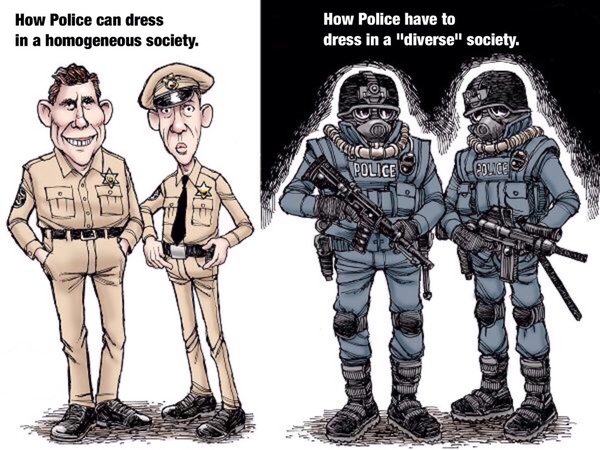
The police in England have become a joke, albeit a sinister kind of joke. Almost unable to do their proper job, completely under the thumb of the Jew-Zionist lobby, and veering from being almost more like social workers than social workers to behaving like total lunatics.
As for that crazed lesbian (I presume) in uniform, she seems to be pepper-spraying bystanders not directly posing a threat. The situation does seem confused, though. Some kind of pleb-brawl.
Looking at the film, there seem to be more police than locals. She is the only police “officer” going crazy.
This officer's a complete headcase. She's a danger to the public and has no place in the force. West Yorkshire needs to address this immediately. Public safety is at stake!
Some women, not by any means all lesbian, cannot handle power, even a small amount; or take themselves far too seriously. You see it at the practising Bar; also, on the lay magistrates’ bench, and on three-person or five-person tribunals (legal, regulatory etc). The po-faced inability to be calmly amused, lest people laugh at you… There’s a lot of that about.
A referral has been made to the Professional Standards Directorate.
Saw a few pro-Israel, pro-Jewish lobby comments and tweets by Tice recently.
He is a waste of space, as is his tiny pseudo-nationalist party. The only good thing about it is that the few mugs voting Reform UK next year will help to bin even more “Conservative” MPs, though Reform UK will not win a single seat. More System-approved fake “opposition”.
If accurate, looks as if the forces of the Kiev regime are being encircled in the Avdeevka area.
Insights from Colonel Douglas McGregor. He claims that US special forces entered the Gaza Strip and "were shot to pieces and suffered heavy casualties" pic.twitter.com/5c8bGMWvSr
I was once introduced by colleagues to a young man in the USA, a Jew who had recently served with the U.S. Navy Seals. As an individual, he was all right, but of course the Israel/US nexus ran right the way through him like Brighton rock.
Tempus fugit…was that really 22 years ago?!
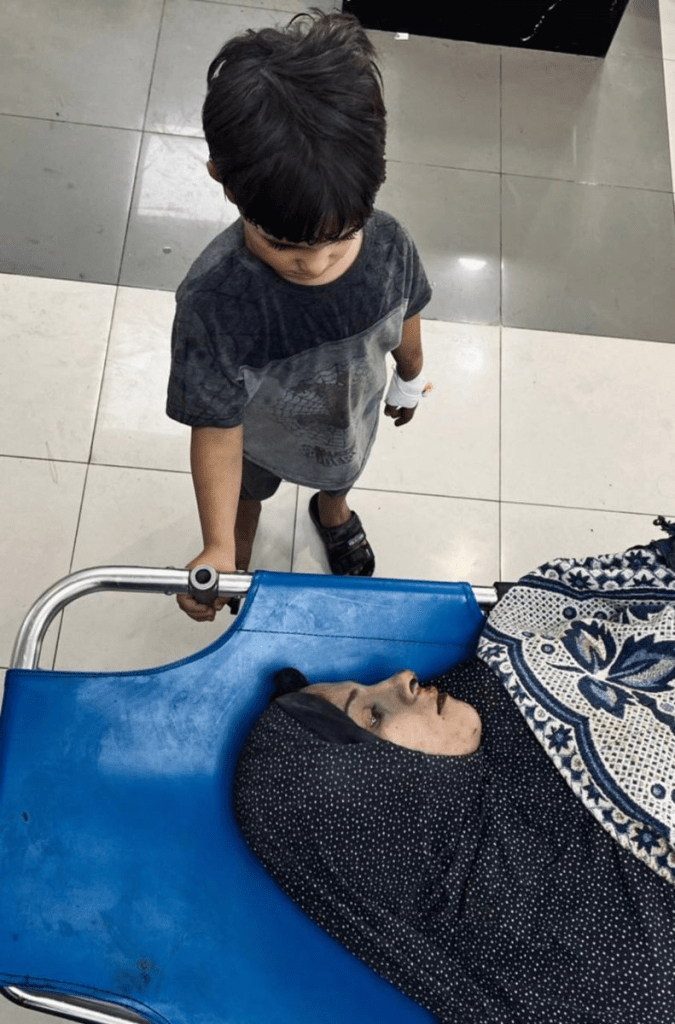
The scene now inside Nasser Hospital in Khan Yunis, south of the Gaza Strip, after the Israeli bombing. Dozens of victims, including children pic.twitter.com/TfPNssbfYq
The Israeli leadership plans to transform the Gaza Strip into a second Hiroshima. This was reported by American journalist Seymour Hirsch, relying on his sources in the IDF.
After the bombing, Prime Minister Netanyahu intends to…
“The Israeli leadership plans to transform the Gaza Strip into a second Hiroshima. This was reported by American journalist Seymour Hirsch, relying on his sources in the IDF. After the bombing, Prime Minister Netanyahu intends to conduct a ground operation in Gaza to destroy all Hamas radicals there.”
As I know only too well, free speech is on the way out in the UK. I am (obviously) not a Muslim, let alone an “Islamist”, but I am not at all “offended” by some foreign person shouting about “Jihad” against Israel in the streets of London. I am not even very offended, or would not be, if the same foreign individual were to cry out for “Jihad” against the UK, or against me personally. After all, the most extreme Zionist Jews have been tweeting malevolently about me for about 13 years. The people of whom to be afraid are those not shouting in the streets.
If foreign (inc. foreign but born here) groups are a danger, then resettle them outside the UK.
As for Suella Braverman, she (like Jenrick, and Mark Harper, who was weaselling for Israel, as usual, on Sky News this morning) is just another doormat for the Jewish lobby. She has no idea of much, either politically or, I think, legally. A silly woman who is trying to position herself to be the leader of whatever small group of Conservative Party MPs is left after 2024.
In the old rhetorical question, how do you shuffle a pack consisting only of jokers?
The only “shuffle” that might have at least a slight effect would be to replace Sunak by someone recognisably English and at least superficially credible. The same with the Cabinet as a whole. At present, the song might be “where have all the English gone?“
Tweets seen
Oct, 23rd: the most violent night since the start of the lsraeli aggression on Gaza Strip. pic.twitter.com/MjrZxnIY7H
If you are interested in giving Prince a loving and experienced home please send us your name and tel. number and a few details of your location and suitability. We will pass these on to Prince’s owner.
— Woodfield Animal Sanctuary (@AnimalWoodfield) October 22, 2023
🔵 On Sunday, Robert Jenrick said the backlog of asylum cases was “falling rapidly”
🗣️ “When I became minister with the Home Office, we were making 400 asylum decisions a week. We’re now making 4,500 asylum decisions a week”https://t.co/nirzIrvm55
Just what does this mean, when one also reads that no less than 75% of “asylum” claims are being approved?!
Just a weasel-trick lie from yet another corrupt puppet of the Jewish/Israel lobby. Just another way of funnelling more non-whites into this suffering country.
Eventually, Israel will be isolated, and its population will be trapped within its chosen boundaries, just as the people of Gaza are now trapped within their never-chosen boundaries.
🗓️ On October 22, #RussianIndian traditional cultural festival was held in #Roerichs' estate in Naggar, Himachal Pradesh.
💃 During the festival the Russian Contemporary Dance Ensemble "Raketa” delivered an unforgettable performance. pic.twitter.com/8k396ahhgW
The tweet refers to Nikolai Rerikh or Rerich, more often known as Nicholas Roerich, the once very famous Baltic German/Russian painter: see https://en.wikipedia.org/wiki/Nicholas_Roerich.
[Roerich Museum, 319 W.107th, Manhattan, New York]
[Roerich Museum, Moscow]
[Nicholas Roerich, Guests from Overseas, showing Varangians (Vikings) exploring the great rivers of Western Russia about 1200 years ago]
[Nicholas Roerich, Lights on the Ganges]
More tweets
The affect of saying that certain chants and actions were okay at the weekend so long as not in Jewish parts of London was to endorse segregation and make parts of our country no go areas for Jews.
Ha ha! No comment, I think, except to say that the word you want is “effect“, not “affect” (but I should not want to be regarded as a “grammar nazi”…).
On September 25, 2000, 19-year-old Kevin Hines attempted to end his own life by jumping off the Golden Gate Bridge. Plunging over 220 feet at a speed of 75 miles per hour, he hit the water below, shattering three of his vertebrae and narrowly missing severing his spine by two… pic.twitter.com/DfKMi0Sq8s
“On September 25, 2000, 19-year-old Kevin Hines attempted to end his own life by jumping off the Golden Gate Bridge. Plunging over 220 feet at a speed of 75 miles per hour, he hit the water below, shattering three of his vertebrae and narrowly missing severing his spine by two millimeters.
Despite the odds, he miraculously survived the impact. Upon realizing he was still alive, an intense will to live surged within him. Yet, the weight of his clothes continuously pulled him beneath the surface of San Francisco Bay. For what seemed like an eternity, he struggled to resurface briefly, gasping for air, just enough to hold on to life.
Suddenly, he felt an unusual force from below lifting him above the water’s surface, where he remained until the Coast Guard arrived. It was only later that he discovered the mysterious presence keeping him afloat: a sea lion had been supporting his body until the rescue boat arrived, as eyewitnesses had observed.
His story gained major media coverage and he has since become a motivational speaker and advocate for suicide prevention.“
Unsurprising. “They” have already destroyed free speech in the UK…
More tweets seen
About 200 thousand residents of Israel were forced to leave their homes due to the worsening of the situation on the southern and northern borders of the country , reports the "Times of Israel".
▪️About half of them were evacuated from 105 settlements located near the borders…
Video of a Lebanese journalist from one of Hezbollah’s underground tunnels, which received a lot of attention on social networks. pic.twitter.com/8RVYeTrmE8
Knowing almost no Arabic, I have no idea what he is saying; maybe praising the build-quality of the tunnel.
As I blogged before, the old Soviet KGB had great expertise in digging tunnels. The one shown above looks well-constructed, lined etc. No idea as to depth, though. Presumably very deep.
The death toll in Israeli strikes on the Gaza Strip has exceeded 5 thousand, and more than 15 thousand people have been injured, the local Ministry of Health reported.
It is not impossible that there will eventually be a kind of sectarian/civil war across Israel/Palestine. The massive military advantages Israel possesses lie in nuclear weapons, tanks and other armour, air power, high-tech surveillance, much of which loses effectiveness or even utility in closely-packed areas (which describes much of Israel/Palestine).
There may be a war, eventually, in which infantry or guerrilla forces play a major part.
Impossible? Maybe, but my prediction, a few years ago, that the Palestinians might break out of their “open prisons” to attack Israeli civilians in Jewish areas has now come to pass in the recent attack on Southern Israel, so who knows?
Senior advisor to Israeli Prime Minister Mark Regev: We realize that the battle will be difficult in Gaza, and Hamas has built a formidable military machine.
As I blogged before, the Gaza situation, as it now is, is most similar, historically, to the Reduction of the Warsaw Ghetto in 1943, but this time the Jews are not the ragged defenders but the heavily-armed and armoured army, with air support, attacking an urban enclave filled with mostly-unarmed civilians (in this case, mostly babies, young children, and young teenagers).
— David Morgan 🏴 #StayFree (@david_r_morgan) October 23, 2023
While they were on TV telling us lockdowns were about the sCiEncE, we now know UK Government ministers were conspiring on WhatsApp to "scare the pants off everyone". They made it up as they went along.
There was no science. This was a complete scam from start to finish.
— David Morgan 🏴 #StayFree (@david_r_morgan) October 22, 2023
Being a Member of Parliament is the only job where you can just not turn up to work whenever you feel like it and still take home a full salary. pic.twitter.com/TxcFxV7CLt
— David Morgan 🏴 #StayFree (@david_r_morgan) October 21, 2023
Breaking | Ministry of Health in Gaza: Three massacres were committed in the last hour in the Shati and Jabalia camps and the Sheikh Radwan neighborhood. https://t.co/2jbM6ALPOO
Gaza death toll passes 5,000 with no ceasefire in sight.
At least 43 percent of all housing units in the Gaza Strip have been damaged or completely destroyed since October 7, according to UN OCHA.https://t.co/frnf3uoNOg
…and in, say, 20 years’ time, when the children in Gaza suffering now are 25-35 years old, what do you imagine will be their feeling about Israel and Israelis? Israel may not —now— much care, but if the results are incursions and massacres on 10x the scale of that recently seen, it will have no choice but to care…
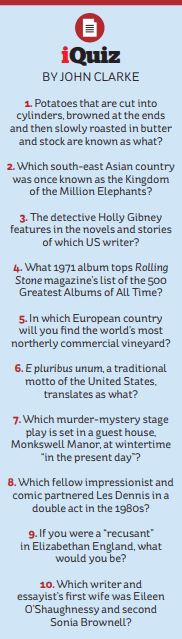
Well, this week brings another win over political journalist John Rentoul. He scored 4/10, but I trumped that with 6/10. I did not know the answers to questions 2, 3, 5, and 9.
Human beings are so inventive; there are grounds for optimism.
I remember saying to @Independent editorial meeting in Mar 1997 that even if the opinion polls were as wrong as in ’92, Blair was heading for big majority. Much shaking of heads
“Speak the truth and shame the Devil” [old proverb].
LONDON – The escalation of hostilities between Israel and Hamas could further strain global oil and gas supplies, already disrupted by Russia's invasion of Ukraine, experts have warned. https://t.co/CeFgrSLUJ3pic.twitter.com/gqhC7WsnV9
She is right, and about Elliot Colburn very right (except that his surname is “Colburn” not “Coldburn“). Here he is, the careerist little twit: https://en.wikipedia.org/wiki/Elliot_Colburn. Never really had a job; no profession, either.
Andrew Bridgen is considered very dangerous by the System, because he is an MP, not someone opining on Twitter/X or Facebook. The System will be doing everything possible to have him removed as MP and replaced in 2024 by a Con Party or Lab Party drone who will make the “expected” noises. https://en.wikipedia.org/wiki/Andrew_Bridgen.
Looking also at the present political climate, and the great unpopularity of the present government, it may be that Bridgen has as much chance as a “Reclaim Party” candidate as he would have had as a “Conservative” Party one.
Reclaim Party is a dead duck, in my opinion, but Bridgen has a high public profile, and it is just about possible that, if the Conservative Party vote in the constituency collapses, or reduces by 40%-50%, and if the Labour Party vote only increases slightly, that Bridgen might just manage to come through the middle and win by a short head. A long-shot, but just about possible.
I do not disagree on some of what Goodwin often expresses, but anyone who doormats for Israel and the Jewish lobby (as Goodwin does in that discussion, and in some of his tweets) cannot be respected by me…
"everyone has a moment when their perception flips. The moment I stopped trusting the scientific establishment was when we learnt scientists had lied about their views on the Covid lab leak. And this is the moment I stopped believing in the BBC"https://t.co/FCjN2mJ9dD
“Brits asked: “Which side in the Israeli‑Palestinian conflict do you sympathize with more?”
All Brits: Israel 21% Palestine 17% Both equally 29% Dont know 33%
Labour voters: Israel 9% Palestine 27% Both 35%
Conservatives Israel 39% Palestine 6% Both 27%
18-24 yr olds Israel 11% Palestine 39% Both 16%
Pensioners Israel 37% Palestine 11% Both 36%.”
There should be an MPs’ section (result would be “Israel 90%, Palestine 10%“, looking at how many are either bribed or intimidated by the Jew-Zionist lobby).
🗣 ‘We don’t have either Labour or the Conservative Party meeting voters on issues they care about.’
📺 The Week in 60 Minutes | Matt Goodwin (@GoodwinMJ) on ‘luxury belief’ politicians
Some 2,000 years ago, an accomplished Roman artisan painted this fantastic fresco of a tall, fruit-filled wicker basket covered with a sheer veil to keep insects away.
The transparent veil is such a lovely and skilful detail! 🤩
Ethical question of the day: Israeli soldiers with Settlers kidnapped 3 Palestinians in the West Bank, stripped them naked, attempted to sodomise them, beat, burned & urinated on them! Zero arrests were made…
Incredible that, in 2023, a large organization such as Currys is still unaware that “Jack Monroe” is a total fraud and “grifter”. Still, if you have ever been in any of their stores, you can see that Currys is badly-run, and only saved from being hopeless by the skills of some of their staff, who however, are rather poorly-paid (underpaid).
“Jack Monroe” runs dozens if not hundreds of Twitter/X “sock accounts”, most of which are very obvious.
Incredibly, “Jack Monroe ” now has 507 utter mugs sending her between £3.50 and £44 per month via Patreon. Each. At one time she had over 800, but that fell back to below 400 as she was exposed as a fraud. Seems that another 100+ idiots have signed up in the past few months. Truly it is said that… there’s a new mug born every minute…
"Defeated Tory candidate Festus Akinbusoye made a hasty exit after the result was declared. He rushed into a black Mercedes waiting outside" Why did the Tories replace Nadine Dorries with Festus Akinbusoye? Are they total morons?https://t.co/U4hsnOmDo1pic.twitter.com/bCYfm27gq9
All part of the Coudenhove-Kalergi Plan: select non-whites to become MPs, TV presenters, actors in TV shows etc. Many of the political ones are actually outright frauds, like that Festus character. Shaun Bailey is another one, and he now sits in the House of Lords as a fake “lord”, “lording it” over British people.
What exactly are the academic and professional qualifications of Festus Akinbusoye? He seems to have wangled his way from being an aide to a tory MP to Police & Crime Commissioner. A case of cronies being lined up to fight ex-tory seats?
Tamworth 36% turnout, Mid-Bed 44%. Tamworth 46% for Lab, Mid-Bed 34%. It means in Tamworth 83.5% DIDN'T vote Labour and in Mid-Bed 85%. People want change but they want real change not archaic monolith so-called mainstream parties. You're an idiot to want a vast Labour majority.
“Festus” (in Mid-Bedfordsire) too; he kept his job (and pay) as Police and Crime Commissioner, just in case he failed to get elected. Those “PCCs” are the biggest wastes of space around (arguably). Most of them seem to be both stupid and corrupt.
As for Andrew Cooper (in Tamworth), marginally better, but struck me, reading about him, as pretty stupid.
Thoughts about the by-elections in Tamworth and Mid-Bedfordshire
Obviously, “seismic” for the Conservative Party. I have blogged previously about the by-elections, but will say a little more know that the results are in.
This is surely the end of the road for the little Indian money-juggler, Sunak, and his Government. So far, he has said nothing, and is still in the Middle East, having been doormatting for Israel and the Jews for the past few days.
Will Sunak now resign? If not, his party will undoubtedly be wiped out next year. If he does step down now, it may give the Con Party a slight chance of at least limiting the damage. That would depend, though, on finding a replacement at least superficially credible.
In my view, neither of the Labour victories yesterday were really votes for Labour as such; they were votes for Labour as the best way of defeating the candidate of the “Conservative” Party.
In Tamworth, the rather poor Con Party candidate still received 40.7% of the vote (Lab 45.8%). In Mid-Bedfordshire, “Festus”, the Con Party candidate, received 31.8% (Lab 34.1%).
Both were fairly close contests, but their importance lies in the fact that both had been considered pretty solid Con Party seats, despite the poor quality of both MPs elected in 2019 and previously.
At present it looks as though the Con Party may be left with about 50 seats after 2024, unless something huge happens in the meantime.
What else? Well, the LibDems performed very badly, especially at Tamworth, where the LD candidate, an Indian barrister, received a vote of only 1.6%.
As far as broadly “nationalist” candidates and parties are concerned, poor in both contests. The barely-nationalist Reform UK, the latest Farage-ist vehicle, scored 5.4% at Tamworth, and 3.7% in Mid-Beds. Underwhelming, looking at the surrounding circumstances.
Reform UK will not get anywhere because it is not social-national. A less globalist Con Party, really. It may even have been set up as a “safety valve” to prevent a social-national party from emerging.
Rump UKIP, and Britain First, both stood at Tamworth. Both lost their deposits.
Conclusion: people generally, even former Con Party voters, want rid of the present Government. The next General Election, sometime in the next 14 months, may be almost existential for the Con Party. 50 MPs, perhaps. That is now a distinct possibility. Unlikely that Con Party will retain more than 100 MPs, even bearing in mind that by-elections are more likely to produce upsets. The turnout in both seats was about half of what it was in 2019.
I detect no real enthusiasm for Labour, though. These two results were both caused by people voting tactically to remove candidates of a party now almost universally despised (and which has been unwilling to face the electorate, despite having selected 2 new PMs, for 4 years).
The “Conservative” Party MPs are saying that it will all be different at the 2024 General Election. Really? Why? Why should it be? I think, on present evidence, that the result will be much the same as yesterday, though with a slight adjustment in the Con Party favour, by reason of higher turnout and because some may have reservations about creating a Labour “elected dictatorship”.
Starmer is just a puppet, a mouthpiece for Israel and the UK/American Jewish lobby.
Silent fireworks are now easily available (this display was in Asda in the U.K.). Please consider using these, pets and wildlife will thank you for it 💜 pic.twitter.com/MHEzOXOhYZ
— Woodfield Animal Sanctuary (@AnimalWoodfield) October 20, 2023
Late tweets
1997: we need mass immigration to pay for your pensions
Incidentally, I happened to notice that some idiot (presumably, some Jew or other, going by the pseudonym @joel_a_t) is claiming that I am back on Twitter/”X” as the account above, @RealBlackIrish. Not so, though RealBlackIrish is certainly usually worth reading.
I myself have not posted on Twitter/”X” since a pack of Jews finally managed (via concerted complaint etc) to get my account removed, in 2018.
She was in her 40s, came to us when she was no longer needed by a local trekking centre. We were so glad we could give her a happy retirement. Favour was a beautiful soul who particularly loved foals and her adored Teddy ; they both ate from the same bucket 💜 pic.twitter.com/O8beff7boV
— Woodfield Animal Sanctuary (@AnimalWoodfield) October 20, 2023
The majority of supporters of the US Democratic Party and Biden do not support the position of the American president in the conflict in the Middle East and advocate humanitarian assistance for the Gaza Strip. pic.twitter.com/KqcvylJXk1
Remarkable overall, especially bearing in mind the Jew-Zionist stranglehold over the American mass media.
🇺🇳 The UN reported that as of October 7, about a third of all residential buildings in the Gaza Strip were destroyed, damaged or uninhabitable. pic.twitter.com/pKaRamBUip
Ludicrous, tokenist, monkey-on-a-stick and puppet for the Israel lobby.
See Lammy trying to answer a few not very difficult quiz questions:
If or when Labour forms the next UK government in 2024, that will be “our” Foreign Secretary…At least James Cleverly, useless and stupid as he is, is nonetheless somehow wise enough not to pretend that he knows anything or is anything much beyond useless. A lesson Lammy has never learned.
By comparison, the UK overall has an average population density of about 280 persons per square kilometre, the highest density being in London (about 5,500 per square kilometre).
Imagine about a quarter of the population of London (c.2M) being ordered, effectively on pain of death, and by an alien force, to move from one end of London to the opposite end. Hospitals full of immobile patients; infirm or sick people without road or other transport; babies and small children; companion animals too.
That is what the Jews of Israel, and egged on by most Jews outside Israel as well, are visiting upon the mostly helpless population of Gaza.
Not just Jewish bullies. Inhuman. Their behaviour is inhuman.
In the 1970s, 1980s, 1990s, the Provisional IRA conducted a terror campaign in the UK from bases in Ireland, some of which were in the Republic. Some “mainstream” Irish TDs (MPs) of the post-1949 era, and even one or two Irish taoiseachs (Prime Ministers), such as Charles Haughey and Sean Lemass, were pro-IRA to a greater or lesser extent. The UK did not bomb Dublin or Dundalk, still less invade the Republic.
More tweets seen
Some friendly advice Prime Minister in CAPS 😊 Nothing should stand in the way of us keeping ALL communities safe in OUR country We DO NOT have a hierarchy of races or communities in the UK and we DO NOT play divide and rule We should ALL stand united against ALL forms of hate https://t.co/H3MVpIZyeQ
“Baroness” Warsi is and always was a waste of space, but at least she is not a complete puppet of the Israel/Jewish lobby in the UK. Sunak is. Starmer is.
That ridiculous creature Suella Braverman also is completely in the Zionist pocket. Married to a Jew, she now seems to be moving from a position (some time ago) of support for “free speech” to, now, one of saying that anyone criticizing Israel or Jewish behaviour, or supporting the people suffering in Gaza, will face prosecution.
I know that she was never much respected when she worked as an ordinary barrister, but this is moving to a police-state position on freedom of expression.
In fact, how long will it be before anyone in politics, law, the mass media, will have to pledge allegiance or fealty to the Jews and Israel, or face complete “cancellation” professionally? It has already gone some way towards that in the UK, USA, Australia, even France and Germany.
A —superficially— “velvet glove” type of finance-capitalist “Stalinism”, if you like.
When Suella Braverman made her speech about migration-invasion recently, I found some aspects of it with which I could agree, despite (of course) believing that persons only notionally British should not be Cabinet ministers, or indeed prime ministers.
However, any UK politician who curries favour with the Jewish lobby/Israel lobby is not one who deserves any respect at all.
Incidentally, she has now thrown the “Community Security Trust” or “CST” (the Jew-Zionist strongarm and snoop organization) another £3M of taxpayers’ money (they were given £14M just recently).
I read about that the same day as I found out that a hospice known to me, a wonderful peaceful place which I visited several times about 6 years ago, may have to close because it faces a financial shortfall of “only” £100,000. About 11% of its income comes from government funds.
£3M given to an organization controlled by ultra-wealthy Jews at a time when hospices (etc) are closing because Suella Braverman’s government will not supply more money (a small fraction of the monies given to the “CST”).
The priorities of UK politicians are rotten to the core.
Well said. You go with truth and what your heart is telling you 🙌🙌💜💜💜💚💜
The Bealtaine Cottage lady’s website is very interesting, and I say that despite the fact that she blocked me on Twitter, when I still had a Twitter account (a Jew cabal pressured Twitter to expel me by 2018), simply because (once again— it’s ALWAYS “them”) a Jew kept contacting and harassing her, misrepresenting my socio-political views.
I like to think that I am a fair person…#MoralHighGround.
Has any one got a second hand Site Office, or a similar building for sale ? Within a reasonable distance of South Wales? Wanted for very busy Animal Sanctuary 💜
— Woodfield Animal Sanctuary (@AnimalWoodfield) October 16, 2023
Owen Jones
I see that Owen Jones has contrived to get more public attention:
What Jones fails to point out is that that British-imposed law probably had a penalty for breach of a small fine or a short prison sentence. I admit that I do not know exactly how much or how long. The Arab/Islamist penalty (I presume, and have seen news to that effect previously) is something like getting thrown off a building, or getting a bullet in the head.
When I was practising at the Bar in London during 1993-1996, I used to do quite a bit of Judicial Review work at the High Court. Most, though not all, was either immigration or housing-related. One such case was a Pakistani fighting deportation to Pakistan on the ground that he was a member of an Islamic sect considered heretical by the other Muslims.
I think, subject to correction, that there are about 70 different sects in Islam.
The said “heresy” was punishable (probably still is) by a maximum penalty of death. The original law prohibiting such belief and/or membership had been passed by the British rulers under the Raj, in the 19th Century.
The devil is in the detail. The original British law provided for a small fine by way of punishment. After Independence and Partition (1947), the law itself was kept exactly as it had been when first passed, but the penalties increased gradually from that original small fine to larger fines, terms of imprisonment, and finally (I think in about 1980 or so) to the death penalty.
The outcome of that case at the High Court in ~1994 is not relevant to my point but, as far as I can recall, the case was listed before a judge who said that he had made a study of the particular sect in question (God knows why). I suppose that he was well-placed to judge the matter fairly. I think that he remitted the case to be reviewed further by the Home Office in the end.
The Israeli Air Force bombed the National Arab Hospital in Gaza, the number of dead and wounded goes into the hundreds. The hospital housed a large number of victims of past Israeli strikes, and there were a large number of refugees and relatives of victims in the hospital… pic.twitter.com/jgLre1lJim
The Israelis go ever-lower. Bombing a hospital. Plainly a war crime.
UN restrictions on the use of missiles and drones on Iran will expire tomorrow, allowing Iran to export more advanced weapons, including ballistic missiles.There are reports that Russia may buy ballistic missiles from Iran. pic.twitter.com/c7qteFw0eD
Are such missiles being too widely-dispersed? Surely Clausewitzian doctrine, as developed over the past 200+ years, demands a concentration of forces to create a Schwerpunkt in or on the enemy territory?
Russia's growing oil revenues have cast doubt on the effectiveness of sanctions
The American publication reports that oil supplies from Russia between October 8 and October 15 reached a three-month high. "Russian ports shipped about 3.51 million barrels of crude oil per day, up… pic.twitter.com/Cv6W8GFmDR
Douglas McGregor Former Pentagon adviser Colonel on social network X:
“Ukrainian President Vladimir Zelensky, although he demonstrates feigned confidence, does not hide the fact that in Europe and the United States, support for Washington’s proxy war is gradually declining.
IDF press service: “ We are preparing for the next stages of the war. We haven't said what they will be. Everyone is talking about ground attack. Perhaps it will be something else "
Perhaps the Israelis are planning to simply reduce the main populated parts of Gaza to rubble, like the Romans did to Carthage, so that no-one can live there for many years, perhaps hundreds of years. They might decide to poison the area with radioactive elements, for example. Very evil.
If what the Israelis are doing right now to the Gazan population is, as they and their Western mouthpieces claim, not a war crime, then there is something wrong with the definition of a war crime.
A brazen attempt to intimidate the civilian populations of Lebanon.
The US Department of Defense has publicly confirmed for the first time that the special operations-capable 26th Marine Expeditionary Unit, part of Task Force Baatan, is moving toward the Israeli coast.
Until now, reports have been based on anonymous statements from US Department… pic.twitter.com/lF0YhvYvsE
“From the halls of Montezuma to the shores of Tel Aviv”…
“Tripoli“, in the song refers to North Africa, not Lebanon…
Are we moving towards WW3 here? First Jews v. Arabs in Israel/Palestine, then maybe Lebanon (Hezbollah) joining in, and yet another Israeli attack on Lebanon and Syria, then maybe Iran responding. Finally, big-power involvement. USA/NATO, Russia, even China.
Biden plans to ask Congress for about $100 billion in aid to Ukraine and Israel – Bloomberg
Details of the package are still being worked out, and he stressed that the amount will cover the entire financial year. The White House's previous request, which included $24 billion in… pic.twitter.com/K3upMiUOXp
The Israeli attack on a hospital in Gaza is a "heinous crime" and appealed to the international community to abandon double standards, the Ministry of Foreign Affairs of Saudi Arabia announced. Qatar, Turkey, Egypt, Syria and Jordan also condemned the airstrike on the hospital.
However, the United Nations has warned that the ‘spectre of death’ looms over Gaza as hundreds of thousands continue fleeing from the expected Israeli invasion.
Supplies of food, water, fuel and medicines are running dangerously low after Israel imposed blockades on the Palestinian territory.“
[Daily Mail]
[Gaza: a young girl carries her cat as they try to escape]
Israel already carries a very heavy karmic burden of evil; the present slaughter and distress being visited on civilian victims in Gaza (half of the population is under-18, and about a quarter are babies or children under 12) can only increase that.
“Cartoonist Steve Bell claims he has been ‘sacked’ by The Guardian over accusations that some of his work is anti-Semitic.
The veteran artist, who has worked for the newspaper for more than 40 years, said it was no longer willing to publish his artwork after he submitted a controversial cartoon of Benjamin Netanyahu.
In the image the president of Israel was seen wearing boxing gloves and holding a scalpel over his own exposed belly, readying a cut in the shape of Gaza while the caption reads: ‘Residents of Gaza, get out now’. “
[Daily Mail]
[the supposedly “offensive” cartoon of Netanyahu]
A sign of the times.
In 2023, the proper word for the UK is “occupied”…
I do not have much time for any sort of Arabs as a group, any more than I have much time for Israelis or Jews generally (i.e. as a group). Both groups have their positive and negative points. However, both what the Israeli state is doing to the civilians in Gaza, and how the Jews elsewhere in the world are justifying that, is just evil and, in a word, inhuman.
I am reminded of someone I knew slightly in the early 1980s, about 1984-1985, when I belonged to the (now long-defunct, I believe) Kensington Rifle and Pistol Club. I suppose that he was about 55-60. I cannot recall his name.
Born in Gaza (I think) and an odd (?) mixture, half-Palestinian Arab, half-Russian, he was a pretty good pistol shot, and worked as a civil servant. I remember that, one evening, at the Club bar, he invited me to go, on some unspecified future day, to meet his (I think English) wife, but he died unexpectedly not long after, and in an unusual way.
The individual of which I speak worked at a government office very close to Lambeth North Underground Station. Co-incidentally, I myself was also there quite often, because I took part-time (a couple of evenings per week) Russian and German at nearby Morley College in Westminster Bridge Road.
There are or were no escalators at that station, only a large and ancient lift. I sometimes ran up the (about 90-100) stairs to the top, for exercise. It seems that the Russian-Palestinian fellow had no choice but to climb the stairs one day when the lift was out of operation. He got to the top, but suffered a heart attack and died there. The Evening Standard had a small story about it. I regretted being unable to offer his wife my condolences, not knowing her address or telephone number, and never having met her.
That Russian-Palestinian man had told me over a drink at the Club bar about how, in the Palestinian refugee camps of the day (1980s), sanitation and water supply were very basic, probably more so even than today (until a week or two ago, anyway), and how if a child lived to age 2, he or she was almost invulnerable to disease caused via bacteria, because the immunity was so strong. He himself cannot have been born in such a camp, though, because he must have been born in the 1920s, maybe early 1930s, before the Nakba (the late 1940s ethnic cleansing carried out by the Jews).
Just a stray memory or two…
🇵🇸🇮🇱 Israeli man releases a video teasing those in Gaza for not having water or electricity. pic.twitter.com/EKhK2y20yF
Bombing cheered on by Jew-Zionists, in the UK and elsewhere, who claim that they feel “terrified” at (almost non-existent) “antisemitism” in their safe suburbs etc…
🔵 Liz Truss is to challenge Rishi Sunak’s government with a so-called alternative budget
👀 It will come a year after Truss delivered the “mini-budget” which preceded her downfall as prime ministerhttps://t.co/hMg0DJW43i
I have no idea whether Liz Truss has some kind of deluded “plan” in doing this. Does she not understand that she and Woollyhead Trussbanger (Kwasi Kwarteng) lost what little credibility they ever had a year ago?
Actually, why is she doing this? Can it be that she thinks that after the quite likely wipeout this Government is probably going to experience in 2024, whatever is left of the Parliamentary Conservative Party (maybe as few as 50 MPs, maybe 100 or so) will turn to her?
That’s the Union Flag or “Jack”, not the Israeli flag. Anyone confusing the two (stand up Suella Braverman, Rishi Sunak, Starmer, Farage etc) should go to Specsavers (or, better still, get lost).
Kay Burley: "Whats the view on the humanitarian crisis in Gaza this morning?"
The Israeli ambassador to the UK: "There is no humanitarian crisis…"
As someone once said, “the simulacrum of the human“. There may soon be robots with more humanity than her. That Israeli bitch cannot interact (even with someone, Kay Burley, who is quite pro-Jewish) in anything approaching a civilized manner, let alone a diplomatic manner. Why is she polluting our English air?
The Jerusalem Post confirms our assumption that the delay in the start of the IDF ground operation in Gaza is due precisely to the uncertainty of the Lebanese Hezbollah’s goals. Tel Aviv fears that as soon as the IDF gets involved in fighting in Gaza, a Hezbollah attack from the… pic.twitter.com/BmMSUVDitn
“The Jerusalem Post confirms our assumption that the delay in the start of the IDF ground operation in Gaza is due precisely to the uncertainty of the Lebanese Hezbollah’s goals. Tel Aviv fears that as soon as the IDF gets involved in fighting in Gaza, a Hezbollah attack from the north will follow.”
Ukraine survives only thanks to American help – recognition of the head of the US Treasury pic.twitter.com/etk2izXvif
On the wider point, people in the UK, USA etc should be aware of the open hatred those shown above (even those brought up in the USA) have displayed toward their host population and against those of white Northern European ethnicity generally.
Not all Jews have the above-displayed genocidal enmity against white Northern Europeans, but many do. I myself have seen it.
War crime is not the befitting word for whatever Israel is doing to the people of Gaza in #Palestine. Israel is committing a genocide and is supported by the super power countries while they know the truth. Where's humanity? What has the world come to? pic.twitter.com/G4rzGeqyl2
It is now an ethical duty for those who have any kind of public platform, even one as relatively little-seen as my blog, to stand up against the Israeli war machine and repression apparat.
If the intention of the Israeli government is to seize about half of the already-crowded Gaza Strip, and to force the 2 million inhabitants (half of whom are under-18) to exist somehow in the remaining half —or even third— that would create social and living conditions far far worse than those seen even in the much-publicized Warsaw Ghetto of the early 1940s.
More than 2,200 Palestinians, including 700 children, have been killed in Israel's war of extermination in Gaza, backed by the US and EU. Three hundred people were killed on Saturday alone. Others are still missing under the rubble.https://t.co/oiu0e638Lt
What “Westerners” are up against here is the mindset of a tribal people whose designated ancient history, and religious celebrations right up to the present-day, are largely about ethnic supremacism, ethnic cleansing, wars against other peoples etc. Look at the Old Testament.
Those who, like most white Northern Europeans, think by default as post-Enlightenment liberals, do not understand much of the Israeli mindset, which somehow bypasses those liberalistic Enlightenment values, just as Hebrew, a dead language in the 19th Century, was deliberately resurrected for use in the 20th/21st centuries.
I’m asking Chief Constable @SYPLPoultney why her force allowed a pro-Hamas checkpoint to operate for at least 2 hours in Sheffield, so that Jews like us had to drive through, not knowing what might happen. https://t.co/8hJDN5xCpO
Jew-Zionist loony and troublemaker complains to the Sheffield police, and somehow contrives to make himself and his wife “victims”, even though nothing happened to them, no threats were made, and they simply drove through a pro-Palestinian demonstration in a matter of a few seconds. Typical…
Dear John Simpson, Nelson Mandela didn't behead babies, rape women to death and then parade the bodies of innocents through then streets of South Africa. A world where the people who did these things become 'global heroes and icons' is not a world most of your viewers will want… pic.twitter.com/rbpoCvtJvP
Thick part-Jew trustafarian Zac Goldsmith seems unaware that Mandela was tried, convicted, and imprisoned not for his simplistic and stupid political views, but for conspiring to start a terror campaign and race war in South Africa: see https://en.wikipedia.org/wiki/Rivonia_Trial.
At that trial, the defendants were all Africans or Jews, and the defence lawyers were almost all Jewish. One defendant was acquitted at the direction of the trial judge.
Incidentally, Mandela was allowed to give a three-hour-long speech from the dock. Try doing that in the UK of 2023!
“At the beginning of the defence’s proceedings, Nelson Mandela gave a three-hour speech from the defendant’s dock, in which he explained and defended the ANC’s key political positions.
He justified the movement’s decision, in view of the increasing restrictions on permitted political activity on the part of non-White Africans, to go beyond its earlier use of constitutional methods and Gandhian non-violent opposition to the state, embracing a campaign of sabotage against property (designed to minimize risks of injury and death), while also starting to train a military wing for possible future use.” [Wikipedia].
Iran doesn't hate Jews, but in fact Iran is home to REAL Middle Eastern Jews who have lived in the region for thousands of years, and they didn't suddenly come from New York to colonise the land pic.twitter.com/WT9qNCiDxR
The IDF requested the US to send all their Tamir missiles, which are used by the Iron Dome defense system.
The US sent all they had, amounting to only 312 rockets. This clear signal indicates that Israel is suffering from a shortage of these missiles. pic.twitter.com/rGEC7DOfch
I have no idea whether either the facts stated, or the conclusion. are correct. Interesting, though.
A Senior Israeli Official has announced that Intelligence has been received which indicates Iran is attempting to move “Strategic Weapons” into Syria in order to Open another Front against Israel. pic.twitter.com/RxVPlFjAnh
Maureen Lipman, the Jewish actress, has “threatened”, a number of times over the years, to leave the UK by reason of supposed “antisemitism”. Strangely, though, it never seems to happen.
I'd list the antisemitic incidents – small & large – I've suffered in my 53 years in England, but would anyone really care?
They've convinced me that, no matter how "civilised" or "compassionate" this country claims to be, if it really came down to it, we Jews are on our own.
Why does @ChtyCommission allow Zionist groups to ‘police’ UK citizens using tactics synonymous with The Cheka police. How long before ‘volunteers’ claim leather coats on expenses? Make no mistake #Chekism is alive and well just watch Joe Glasman’s video. https://t.co/zZvuGe5HWg
A few years old, but worth seeing again as the (tiny but very well-funded) Jew-Zionist “Campaign Against Antisemitism” ramp up their attacks on free speech in the UK.
#BBCLauraK Lammy just said, live on BBC, The Labour MPs & Counsellors must NOT attend a Pro-Palestinian rally.
When asked " Can they attend a Pro-Israel rally" he said "Right of protest is very important".
Lammy is as thick as two short planks. As with “Boris”-idiot, Liz Truss, Shapps etc, the fact that such useless wastes of space can now climb to the upper levels of our political life says something not very positive about our society.
At least for Jews we can always go to Israel. The others are stuck in this cesspit.
According to Malcolm Rifkind the Israeli government is not ordering civilians in Gaza to move south. It is simply a suggestion. A matter of common sense. We would appear to be in the ugly Tory moral territory of Rees-Mogg on the people who died in the Grenfell Tower fire.
Malcolm Rifkind currently arguing on Kuenssberg that Hamas having hostages wholly justifies 2.2million civilians being made to die of thirst, starvation or lack of sanitation. This country is unhinged.
So tweets the wannabee “victim” loony and troublemaker referred to earlier.
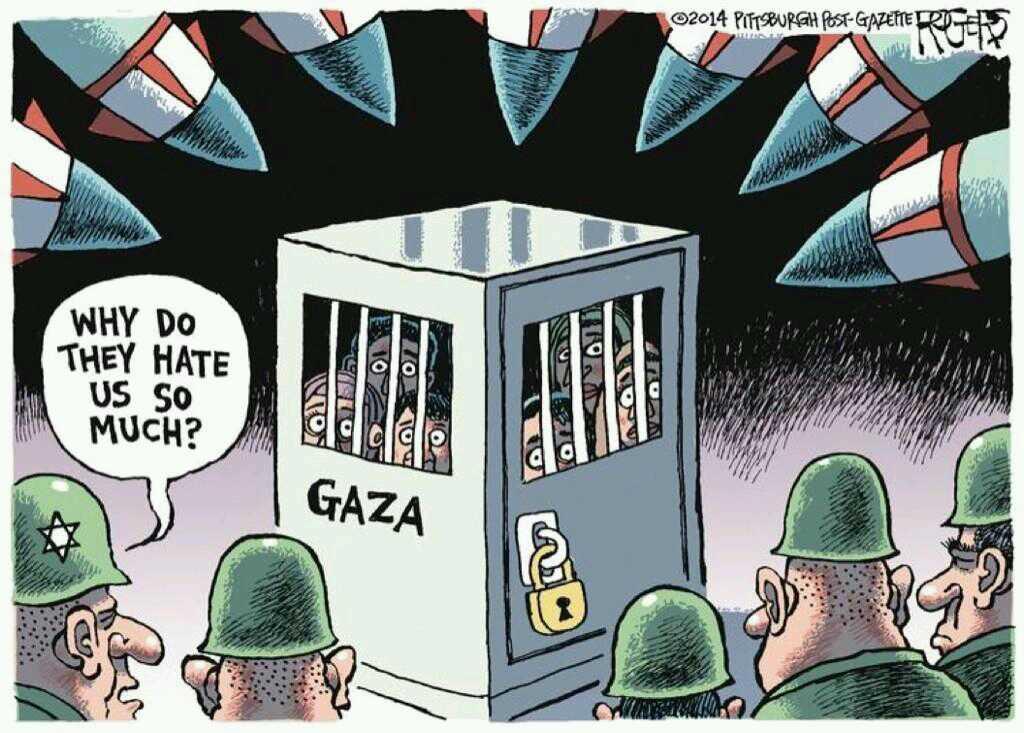
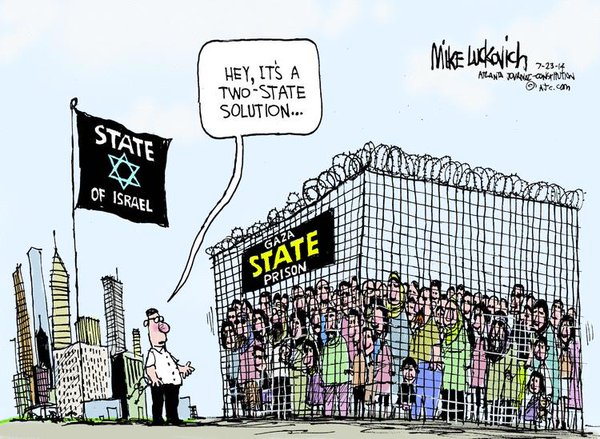
My attitude to the present Israel/Palestine situation can probably be summed-up by the cartoon below:
Threatening people with police action for expressing their (albeit misguided and hateful) opinions is not a productive or ethical solution. While it's understandable to feel outraged and disgusted by these abhorrent views, the answer isn't to criminalize them, but rather to…
What about the UK-based Jew-Zionists applauding the slaughter of civilians (many of them children) in Gaza, whether or not those Jews usually say, in effect, “oh dear, how sad, never mind” (and place the blame with the Gazans for not surrendering every last vestige of human rights to the Israeli ethnostate)?
Suella Braverman is Priti Patel Mark 2: plenty of tough words about the cross-Channel migrant-invaders, but little action, little plausible policy, and completely in the pocket of the Jewish/Israel lobby. Another waste of space.
So Israel should right the wrongs that they can. Don't expect a people to peacefully accept dispossession and life in a concentration camp.
This is what the dried-up Kakhovskoe reservoir in the Nikopol area looks like now. The bushes there are already under 4 meters. A couple more years and no one will remember that there was once water there pic.twitter.com/1XJcOFeigT
“Israel’s deadly strikes on Gaza have led to an “unprecedented human catastrophe”, announced the UN agency for supporting Palestinian refugees UNRVA.
The general secretary of this agency, Filip Lazarini, told reporters that “not a drop of water, not a grain of wheat, not a liter of fuel has been allowed in the Gaza Strip for the last eight days”.
“Gaza is suffocating and it seems to me that the war has just lost its humanity,” he said.”
As the number of resistance rockets fired increases, the Israeli Iron Dome is forced to prioritize and attack a target that is on its way to hitting the city.
According to Israeli media reports, Iron Dome was forced to do so the night before in Tel Aviv, which shows the… pic.twitter.com/C03J1RNz5M
“As the number of resistance rockets fired increases, the Israeli Iron Dome is forced to prioritize and attack a target that is on its way to hitting the city.
According to Israeli media reports, Iron Dome was forced to do so the night before in Tel Aviv, which shows the seriousness of Hamas’ rocket operations.“
There is nothing much that the Palestinian Arabs can do to counter the massive Israeli military force in the field. They do not have jet fighters, tanks etc. However, in the close confines of Gaza, especially Gaza City, it may be a different story, one more akin to some of the battles seen over the past year in Ukraine; or at Stalingrad 80/81 years ago.
Well, not so good this week: 4/10, though that was still enough for me to beat, yet again, political journalist John Rentoul (who scored 3/10). I knew the answers to questions 1, 6, 7, and 9.
The NWO/ZOG conspiracy has been exposed —yet again— in the past week. The masks really have come off. Von der Leyen, Macron, Nigel Farage etc, as well as more obvious puppets of Israel and the Jewish lobby such as Starmer, Sunak, and the “tail wags dog” American government and msm.
Tommy Robinson [https://en.wikipedia.org/wiki/Tommy_Robinson_(activist)] gives his opinion. He claims, with reasonable plausibility, that he is not getting money directly from Israel (though that leaves in the air the question of from where he does get the money upon which he lives in his Spanish exile).
I slightly sympathize with “Robinson’s'” dislike of Hamas and even Fatah, but he seems unaware or uncaring about the strategic “big picture” that has unfolded since 1948 in Israel/Palestine.
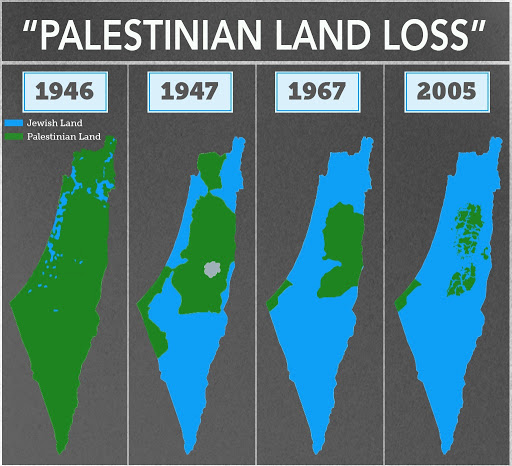
I should be interested to see a similar graphic, I suppose it would have to be an ordinary graph, showing the amount and/or proportion of the UK economy controlled by Jewish interests in 1890, 1923, 1956, 1989, and this year.
“Robinson” might care to factor-in to his future comments the question of which group or groups control the political and msm narrative(s) in the UK, and in the West more generally. Not Hamas or Fatah, and not —most of the time— the Muslim community or communities, but mainly the Jewish lobby and/or Israel lobby.
If the Palestinians supporting Hamas (etc) are monstrous, they have been made monstrous— by Israel.
“Counter terror police in Sussex have arrested a woman on suspicion of supporting a proscribed terror organisation following a pro-Hamas protest in the city.
The woman is believed to have made a speech at the event.
Superintendent Petra Lazar from Sussex Police said: “After reviewing footage from the protest event held in Brighton on Sunday October 8, the matter was investigated by Counter Terrorism Policing South East. We will continue to support them as they conduct their investigation.“
[Jewish Chronicle]
Wait a minute….what was that name again? Superintendent Petra Lazar?!
Did you hear the statement by the Israeli Minister who openly called for the "erasure" of the city of Hawara from existence, which is a strange statement that clearly incites ethnic cleansing in Gaza#طوفان_الاقصى_#Gazagenocide#غزة_الآن
My name is Elin. I’m no longer alive although I loved life. 🇵🇸 Israel bombed my family, I heard screams, then nothing. I was not used as a human shield, actually I was in the area they told us to evacuate to.
I’ll be totally honest: I never expected large scale ‘population transfers’ of more than a million people gleefully given green light by Western governments in the 21st C
It’ll take months but beneficiaries are Russia & China. The West has just jettisoned any moral authority.
That is probably the first time I have ever agreed completely with anything tweeted by Aaron Bastani. Perhaps I should have it framed.
The West has lost moral authority. That is what happens when your governments are corrupted by Jew-Zionism not only in the Middle East but also in our own countries; in the UK, USA, France, Germany etc.
I should date the loss of American moral authority specifically (despite all that has happened since 1776) mainly to the events that happened in Iraq and Afghanistan a couple of decades ago, and what flowed from those invasions. The terrible Abu Ghraib, Bagram and other torture programmes, including so-called “extraordinary rendition”; also including the concentration camp at Guantanamo Bay.
'The emptiness of Keir Starmer'
Ralph Schoellhammer, Tom Slater and Fraser Myers discuss the Labour Party’s drab, technocratic vision for the UK. pic.twitter.com/X7YANMCyTc
Saw many tweets etc against the Jew Shapps; a few in his favour, too. What strikes me as incredible is that many discuss his words as if the fact that he is a Jew (indeed a fanatical Zionist Jew) is not really relevant! “After all, he has a UK passport“, “he was born in the UK, in Hertfordshire” etc…
At least with the Israeli Jews in positions of political authority, you know that almost all of them have been in uniform, and quite a few have seen action (i.e. what you see is more or less what you get) but in Britain we now have the Shapps type, who really know nothing about defence or anything else. Not only Jews, incidentally— look at, to name only one other, Gavin Williamson. I blogged about him 4+ years ago: https://ianrobertmillard.org/2019/05/02/deadhead-mps-an-occasional-series-the-gavin-williamson-story/.
Actually, Britain cannot “go to war” anyway. For that, you need a functioning Army, Navy, and Air Force. Our very-reduced armed forces are now almost powerless, and indeed almost useless. In fact, I begin to wonder what is the point of even having them. Our very borders are open to any who wish to cross the Channel in a rubber boat. Migration invasion.
Grant Shapps, transport secretary who failed to keep HS2 costs under control. Rewarded as defence Secretary. This is what we live in.
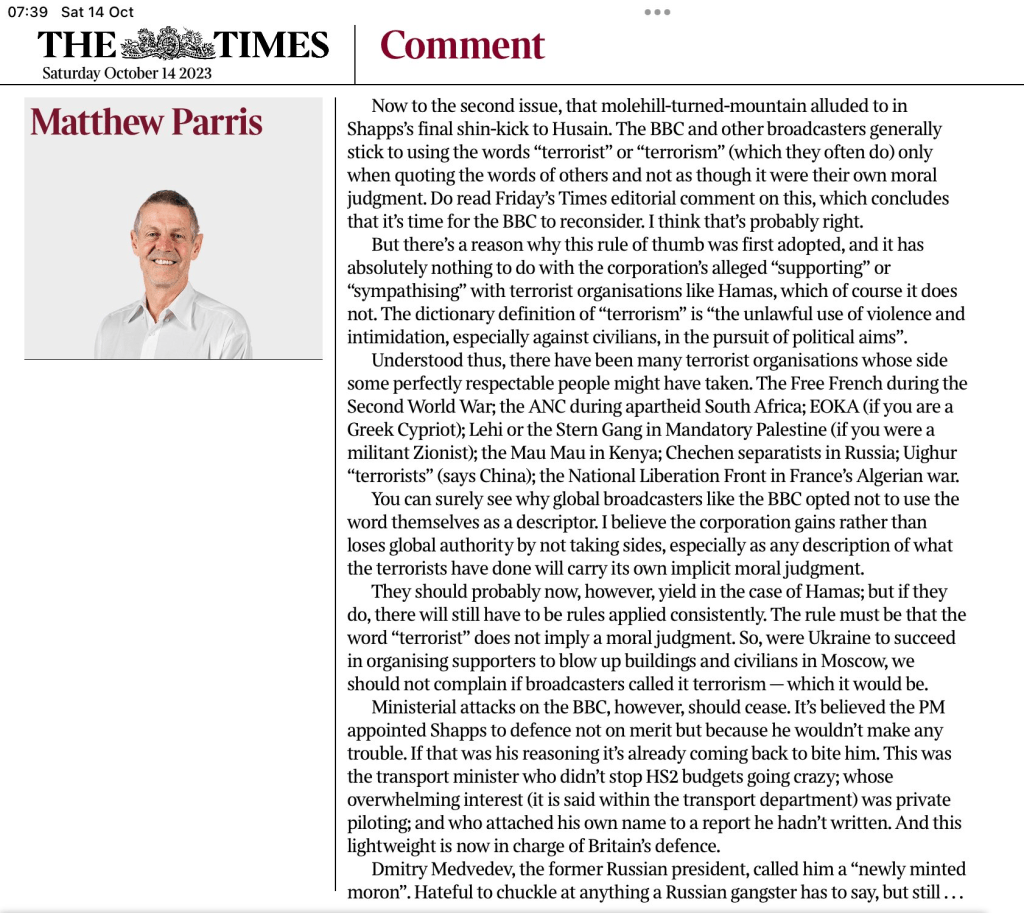
Needless to say, Matthew Parris fails to note that Shapps is a Jewish Zionist. I suppose that Parris wants to keep his job; anyone even noting en passant whether someone, even someone as incompetent and dishonest as Shapps, is a Jew, faces loss of job, loss of money, etc, maybe even prosecution…in fact, the Zionists rely on that kind of intimidation (in Europe, where the Jews have no Israeli Defence Force or secret police with which to frighten people).
Since the recent Gaza events, I have seen several tweets by well-known Jews in the UK effectively threatening to report to police, presumably to those police playing at “counter-terrorism”, anyone criticizing the Israeli actions.
Typical.
Incidentally, I have today seen tweets by Jews in the UK who support the Israeli actions, one saying that “In 2008, during [Operation] Cast Lead, Hamas had rockets that could only go a few kilometers. Now they can go 250 km. In 2008, Hamas didn’t have drones, amphibious assault teams, anti-tank missiles, anti-aircraft missiles. Now they do.“
I agree with that. The operational capabilities of Israel’s enemies, both in Palestine and elsewhere, have grown greatly. The population of Tel Aviv will, sooner or later, be protected from air attack little more than is, now, the unfortunate population of Gaza.
In the old proverb, “old sins cast long shadows“…
More tweets seen
The Crimean Bridge was completely restored 18 days ahead of schedule and traffic was opened on all four lanes – Russian Deputy Prime Minister Khusnullin pic.twitter.com/nJwhLll9nL
Very English (to remove the flag, rather than… well, ’nuff said…).
The virtue-signallers have moved on. “Ukraine” (Kiev regime) is no longer flavour of the month. Now it is Israel (oddly; after all, a vast mechanized war machine is attacking a largely-unarmed civilian population, half of which is under18 years of age).
The whole of Avdeevka is burning, heavy fighting is taking place, the Russians are advancing for 4 days.
The head of the local administration, Barabash, commented on the 4th day of massive shelling and assault by the Russian Armed Forces pic.twitter.com/Jj6XfgrsJY
Russia will eventually triumph in Eastern Ukraine (Ukraine east of the Dnieper). The Kiev regime is living on borrowed time.
US sends warplanes to Middle East to contain Iran
The purpose of the transfer of equipment is to “contain Iran and regional groups” from interfering in the Palestinian-Israeli conflict. This was reported by the Air Force Times, citing a source in the Pentagon. pic.twitter.com/iP5IKuw9Wu
In other words, the Americans (US Govt, not ordinary Americans) are going to allow the Israeli Jews a “free hit” on the population of Gaza, half of whom are under 18, and at least quarter of whom are young or very young (0-12) in age.
It's incredibly rare in our modern politics for someone to rise above Party tribalism and act purely on their principles. Whether you agree with him or not, that is what Crispin Blunt is doing here.#IsraelPalestineConflicthttps://t.co/zNLVhqkl6X
We’re into the eighth day of Israel’s assault on Gaza now and so far they have killed about 700 children. That’s an average of 100 PALESTINIAN CHILDREN KILLED EVERY DAY!!!
Genocide doesn’t even go far enough to express this reality.
While “technically” perhaps not genocide, this is at least quasi-genocide.
Again it strikes me that, while the Israeli Jews kill tens of thousands (which may eventually be hundreds of thousands) in Gaza, the most vocal-on-social-media Jews in England are whining (and lying) about how they and their neighbours etc are “fearful” or “afraid“, or even “terrified” of (very limited, mostly “defensive” and only very rarely physically-manifested) “antisemitism” in the UK.
Most probably she's injured and permanently deaf now. Animals, the most innocent casualties of war.
“These animals can no longer live”. 95-year-old Israeli army reservist Ezra Yachin was filmed calling on Israeli troops to kill families and children along with Hamas fighters in Gaza.”
[Al-Jazeera]
What a horrible old bastard. He even says that Jews in Israel who have any Arab neighbours should go to those neighbours and kill them.
Ingrained psychosis.
Late tweets seen
The Israeli army continues to delay the start of the ground military operation in the Gaza Strip.
Now the IDF command has announced that the army will launch a ground operation after assessing the number of residents remaining in the enclave.
“The Israeli army continues to delay the start of the ground military operation in the Gaza Strip.
Now the IDF command has announced that the army will launch a ground operation after assessing the number of residents remaining in the enclave. The ID command had not previously mentioned such a condition. But the world community’s reaction to the events in the Gaza Strip could not but affect Netanyahu and his entourage.
Therefore, for the time being, the decision was made to achieve the evacuation of only the majority of the population from the enclave.
According to numerous Arabic TV channels, more than 800 thousand people have now left the northern Gaza Strip. However, a significant number of civilians still remain in the enclave. If Israel launches a military operation while there are hundreds of thousands of civilians in the Gaza Strip, it will lead to tragic consequences for the population.
In addition, the Israeli authorities fear the risks associated with the start of a ground operation, involving new participants in the conflict, after which the IDF will have to fight on two, and even three or four fronts. In addition, there is a high probability that the US will not become directly involved in an armed conflict.
Therefore, Israel seems to be delaying the start of the operation not to estimate the number of civilian population in Gaza, towards which the Israeli authorities have long shown indifference, but to assess the real prospects and risks of an invasion.”
Many of the “foreign citizens” are in fact Jews. They flee, panic-stricken.
Vladimir Putin, at a meeting of the Council of Heads of State of the CIS, stated the need to create an independent Palestine with its capital in East Jerusalem . pic.twitter.com/EDnG5JAY49
Zelenskiy's former aide calls for the formation of a new government in Ukraine
Kiev has failed to inflict a strategic defeat on Russia and needs a change of leadership, Alexey Arestovich wrote on Telegram pic.twitter.com/BirHIjvew6
The Scottish police, prosecutors and courts seem to be every bit as (((infested))) as one would have expected. The malign influence of (((the usual suspects))), of course.
Tweets seen
They lie a lot to find justification for their crimes committed against the Palestinian people
Stray thought about Gaza, Israeli “military action”, and social media
What strikes me most about the UK Jew-Zionist outpourings on Twitter/”X” is the sheer sadism and hatred many of the Jew-Zionists are putting out. Many of them are gloating about how the civilians of Gaza are about to be crushed, subjected to pain and devastation etc.
Many Jew-Zionists are effectively or actually saying that the Gazan population (half of whom are under 18, and at least a quarter of whom are young or very young children) deserve to be wiped out or, more euphemistically, “taught a lesson they will never forget“.
What makes their comments even more contemptible is that the said Jew-Zionists are sitting in comfort in places such as North-West London, or in other suburban enclaves. They cannot wait for the poor, repressed, and helpless population of Gaza to be killed or injured; they themselves are in no danger, yet they are now already pretending to be “victims” and/or “fearful” that they will somehow be subjected to a pogrom in the UK!
It seems to be an ingrained psychological disorder.
Needless to say, the “holocaust” narrative is wheeled out in support….
More music
[SS-Leibstandarte Adolf Hitler at the Berghof]
[Germany 1945— “We are fighting for the future of our children!”]
More tweets seen
The most comprehensive polling to date shows large numbers of British Muslims, about a third, endorse anti-Semitic tropes like "Jews have too much power". A large majority say they'd sacrifice free speech to defend Islam. Only a minority think the Holocaust happened. A quarter… https://t.co/XpKwzxmKP0
You only have to look at entitled Blairite hogs such as Emily Thornberry…
Under other circumstances, at other times, I should discount Labour’s 2024 General Election chances as overblown, but in 2023 it is just palpable how utterly incompetent is the present Conservative Party government. “Clueless” scarcely covers it. In those circumstances, can Labour “lose”? I cannot see how right now.
Britain is increasingly in the hands of a Luxury Belief Class – a new elite who push ideas like mass migration, open borders & gender ideology which bring them status from other elites and few costs but impose high costs on everybody else My latest in today's Mail… pic.twitter.com/oBNOAXyyI2
Israel's military issued an evacuation order to Palestinians in Gaza, in its strongest hint yet that it prepares to launch a ground offensive almost a week after Hamas's surprise assault.
– ‘We have nowhere to go’: Gaza reacts to 24-hour warning to evacuate – US defence secretary arrives in Israel – Israel has right to ‘go after’ Hamas, says Shapps
Israel ordered the evacuation of more than a million civilians from the entire northern half of Gaza. The UN said the order would lead to “devastating humanitarian consequences,” and Gazan officials told Palestinians not to comply.
Russian and Ukrainian forces were locked in fierce fighting around the eastern frontline town of Avdiivka for a fourth straight day on Friday, in one of Moscow’s biggest military offensives in months.https://t.co/PplfWOFbAw
Last year, that would have been 24/7 news, but this year Israel is the priority; everything else, everywhere else, is secondary. That shows the core of the post-1945 (arguably, post-1956) “Western” world order.
The University of Exeter in England will offer a postgraduate degree in magic and the occult. Coursework will include the study of Western dragons in lore, literature and art; the depiction of women in the Middle Ages; and the philosophy of psychedelics.https://t.co/naz0k1auSy
The Israeli-Palestinian conflict distracts the West from Ukraine – expert
It was no coincidence that the Hamas attack on Israel occurred on Vladimir Putin’s birthday, German expert Thomas Jaeger said in an interview with N-TV. According to him, Russia is benefiting greatly from… pic.twitter.com/hgQXVtWhuq
“The Israeli-Palestinian conflict distracts the West from Ukraine – expert It was no coincidence that the Hamas attack on Israel occurred on Vladimir Putin’s birthday, German expert Thomas Jaeger said in an interview with N-TV.
According to him, Russia is benefiting greatly from the Israeli-Palestinian conflict. Moscow hopes that Western attention and, accordingly, military forces will now be redirected from Ukraine to the Middle East. As a result, support for Kyiv will weaken, and this, in turn, will open the way to victory for the Kremlin.
At the same time, the main events are now unfolding in the United States, where Congress cannot agree on a budget containing financial assistance for Ukraine. The results of this political chaos will predetermine the further development of events.”
YouGov Scottish Westminster Voting Intention:
SNP 33% (-5) Lab 32% (+5) C 20% (+4) LD 5% (-2) Green 5% (-1) Reform 2% (-2)
Fed into Electoral Calculus, the result of such a general election would be: Labour on 504 seats, Conservatives on 64 seats, LibDems on 27, SNP 32, Green 1 (plus a few Welsh and Northern Irish). Overall Labour majority of 358.
That would be a complete elected dictatorship, and one brought about not because voters really like Labour, but because the new multicoloured fake “Conservative” Party is not so much hated as despised (as useless). A Labour Party elected dictatorship by default.
The Conservative Party reduced to 64 seats. Existential peril?
This woman and her children were released by Hamas. Her experience runs counter to everything mainstream media are saying. How odd. https://t.co/hiTYPoCWIU
The Jew-Zionists making up atrocity stories, while themselves carrying out real atrocities. Makes one muse anew about all those fake “holocaust” stories and hoaxes. There are thousands of them.
The Met Police says there has been a 650% increase in reports of anti-Semitism over the last two weeks compared to the same period last year.
Imagine the level of entitlement it takes for Jew-Zionists to sit in the UK, cheerleading the Gaza devastation and slaughter, and at the same time imagining themselves to be somehow “victims”, and demanding the sympathy of the population, police, and courts.
israel is boming the 1 million people in gaza they told to evacuate. the whole evacuation message was only a play to appear humane to media outlets!!! fight this evil propaganda #TheRealImage#Gazagenocidepic.twitter.com/l7hFfVF5IS
🚨BREAKING: Palestinian Paramedics “We were transporting people from the North to the South of Gaza, the Israeli air strike hit the truck and cars transporting the people evacuating! They struck us while evacuating and fleeing!” #GazaGenocide#StopGazaNakbapic.twitter.com/cq3X7EfZsK
At midnight, the Internet will be cut off in the Gaza Strip, following the electricity, so that the number of videos from the region will be reduced to a minimum.
The Ukrainian counteroffensive is over; the Russian Armed Forces have already switched to active combat operations on almost the entire front several days ago. This was stated by Russia's permanent representative to the UN Vasily Nebenzya.
“The Ukrainian counteroffensive is over; the Russian Armed Forces have already switched to active combat operations on almost the entire front several days ago.
This was stated by Russia’s permanent representative to the UN Vasily Nebenzya. “For several days now, Russian troops have switched to active combat operations along almost the entire front line. Thus, the so-called Ukrainian counter-offensive can already be formally considered completed,” the permanent representative said at the Security Council meeting.
According to Nebenzi, this cost Kyiv tens of thousands of mobilized recruits, most of whom did not want to take part in the fighting.“
“Rapists could be spared jail from next week as prisons reach breaking point, it was reported last night.
Sex offenders and burglars could be let out on bail rather than handed an immediate custodial sentence, according to guidance issued to judges.
The most dangerous criminals will reportedly have to be held in magistrates’ court cells if they are remanded in custody.
Prisons in England and Wales are on the brink of maximum capacity, with 88,016 inmates last Friday – leaving just 650 spaces spare.
The senior presiding judge for England and Wales, Lord Edis, ordered that sentencing hearings will have to be postponed from Monday, The Times reported.”
[Daily Mail].
There has been a sentencing crisis for years. While many crimes of drunken violence, acquisitive crime etc attract, quite often, non-custodial sentences, other crimes, often very minor, not only result in prison time but in very considerable time.
Look at the political realm. Harmless teenage fantasists who have downloaded online material such as the notorious Anarchist’s Cookbook (which was sold openly in London bookshops in the 1970s, and without the State imploding) have been sentenced to terms of 4, 5, even 7 years, incredibly. Anything (political or otherwise) involving illicit possession of a weapon (even a WW2 revolver) has attracted sentencing as severe, or more severe.
Likewise, there have been sentenced to prison people such as Alison Chabloz (sentenced to a number of months for posting “antisemitic” satirical songs and cartoons online), Jez Turner (a year, for having suggested in a brief speech in Whitehall that Jews should be driven out from England as they were under Edward I in the 14th Century), and “Sven Longshanks” (James Allchurch, sentenced to a very harsh 2.5 years for having posted “antisemitic” material on an internet radio station).
The alert reader will have noted the common factor in the immediately-above three Draconian sentences, but what do you expect when 10 Downing Street has the Israeli flag projected onto its facade? Or when Keir Starmer, posing as Labour Party leader, thinks that the Israeli ethnostate has every right to cut off water, food, and electricity (and everything else) from the 2 million inhabitants of Gaza.
As far as non-political crimes are concerned, one often sees newspaper reports these days about various types of criminal sentenced to, say, terms of 4, 5, or 6 years in prison, when a far shorter term of, say, a couple of years would really suffice. Likewise, people are sometimes —in fact, often— sentenced to a year or more in circumstances where, even retaining a custodial element, a few months would be more than enough.
At the present time, the crisis of available space would easily be solved if judges were to work out carefully, as they are supposed to do, the proper sentence in every case, but then, after all that, cut off a percentage, as an emergency administrative-judicial measure. Say 20%, so that a headline sentence of 5 years becomes one of 4 years, or one of 2.5 years becomes one of 2 years. That would scarcely impact anything other than space in prisons and, within a few months, would start to solve the present problem.
“Captain Sir Tom Moore‘s daughter has confessed to pocketing £800,000 from books written by the NHS fundraising war veteran.
In a tearful interview, Hannah Ingram-Moore revealed how the family received the money thanks to her father – whose lockdown walks raised £39million for the nation’s health service.
Mrs Ingram-Moore said her father wanted them to keep the profits from his three books: Captain Tom’s Life Lessons, One Hundred Steps and his autobiography Tomorrow Will Be A Good Day.
The family is also adamant that people buying the books were never told their money was going to charity.
However, the prologue of his autobiography calls this claim into question and suggests the veteran thought his books were just another way for him to raise cash.
The extract read: ‘Astonishingly at my age, with the offer to write this memoir I have also been given the chance to raise even more money for the charitable foundation now established in my name.’“
[Daily Mail].
I was in the minority of sceptics when the old ex-officer (he spent 6 years in uniform during WW2) started his “crusade”. While arguably wrongheaded, one had to respect the grit of the old fellow, yet the whole thing played into the “scamdemic” propaganda of the time, and even the £30M raised probably did little to help the maladministered NHS.
I could see that the daughter and her husband were basically a pair of freeloaders, if not outright frauds, but people so badly (and rightly) want to believe. In something. In anything. You only have to look at the well-known online “grifters” and frauds around. “Jack Monroe”, “Supertanskiii”, “Man Behaving Dadly” etc. There are dozens, probably hundreds, of them. They destroy trust in society, as do some of the family of the late Captain Moore.
Apparently, the Israeli regime is preparing for a big war.
In the Israeli territories, an underground parking lot is being converted into a hospital with several hundred beds and medical equipment. pic.twitter.com/wCHothy1C8
#Updates: #Gaza Renewed Israeli air strikes on al-Karama neighbourhood in Gaza Wednesday morning UN says Gaza has food and water for 12 days, after Israel cut all electricity, fuel, food and water to the besieged enclave
The Captain Tom debacle is a prime example of how the media can get people to believe anything and of how dissenting voices are silenced by accusations of being unpatriotic
I think that I may start including a random historical note from Wikipedia etc in all my blog posts. It is quite shocking how few British people know their own history, even in outline.
[little boy and his dead cat, following Israeli air attack on Gaza]
Were the atrocities not so terrible, it would be funny to see the UK Jewish/Israel lobby all both pushing out (identical) Israeli propaganda and —at the same time— saying, when asked about the quasi-genocidal Israeli Gaza siege, and mass murder of Gazan civilians, “oh, no, that has nothing to do with us; we bear no responsibility” and “we are just opposed to antisemitism, the actions of Israel are nothing to do with our campaigning in the UK...”.
Etc.
Typical.
Incidentally, I have never seen political fraud and con-man Nigel Farage so pumped-up as when parroting the current Israeli propaganda line in the past few days.
“In the wake of the merciless assault by Hamas, Israel seems to be planning the same approach.
All the signs are that its government is preparing to retaliate on a massive scale, mobilising the country’s formidable armed forces against Gaza, which is controlled by Hamas.
Yet just as Iraq turned out to be a calamitous error, fuelling a lasting cycle of violence, so I fear that – however understandable – any attempt by Israel to exact its vengeance with a savage display of military might could be just as disastrous.”
“…a full invasion, such as Israel’s generals are surely discussing today, would be a bloody quagmire. For Jerusalem, it would mean a conveyor belt of tired soldiers fighting day and night, resupplying with food, water and military hardware, rotating and evacuating casualties, for months on end.
It would chew up thousands of troops for little or no benefit, and poison the Arab world, and to a certain extent the international community, against the Jewish state.
Alas, it looks like Israel is set to take precisely this route.
Already the country has launched a barrage of air strikes, causing heavy civilian casualties – unsurprising given that more than two million people are living in a strip the size of the Isle of Wight.” [in fact, smaller than the Isle of Wight— 141 sq. miles as against 148].
“This bombardment has been buttressed by a siege designed to weaken the morale of the citizenry by cutting off their water and electricity.
Yet what is the ultimate objective? What does ‘victory’ for Israel even look like?”
[Gaza City, already devastated by Israeli air attack]
It would be even more interesting were Israel to face attack or, even more so, invasion from the directions of Lebanon, Syria, and Jordan, and perhaps even (though even less likely) from Egypt, and if the Palestinian Arabs of the West Bank were also to join in the fight.
The immediately-above scenario is unlikely, true, but the Americans must have some reason to have moved one of their fleets closer to the region.
If such a concerted invasion and uprising were to happen, though, Israel could be destroyed, its population fleeing in panic.
More tweets seen
There is such a disconnect between the stories and videos coming out of gaza and what the politicians and most of the media try telling us and I reckon most of the public recognise that no matter how much Margaret hodge talks over owen Jones about it being an obsessive hobby https://t.co/2stCAcLPZo
— any other leader would be 20 points ahead (@anyotherleader) October 12, 2023
I face trial late next month on 5 counts of contravening the notorious s.127 of the Communications Act 2003 (recommended for repeal by the Law Commission). Behind that prosecution, a pack of Jew-Zionists.
I cannot write about all that prior to trial, for reasons of potential contempt of court etc, but one aspect of the case is that I am alleged to have claimed that, in the UK, most of the TV and Press is effectively in the hands of Jew-Zionists (as Rupert Murdoch said years ago— and he is 100% pro-Israel…).
What do you think, blog readers?
be taken to the Gazza strip to see what the Palestinians are having to deal with, each and every day of their lives. We have, in recent years been too sympathetic to Israel, which, I believe we now have an out of control far right Israeli government. I am not, however, /
Margaret Hodge is just another Jew-Zionist liar and hypocrite.
It is now immaterial. It was used by Western media outlets to whip up hatred against the Palestinian people and rally support for Israel's attack on Gaza. This is a method the UK media always employ. I'm an old woman and I've seen it all my life.
— Mairead #HerdImmunityKills#RealSocialistsWearMasks (@imelda_mairead) October 11, 2023
[Nayirah al-Sabah, the lying Kuwaiti bitch at the centre of the faked 1990 Kuwait atrocity story]
I was in New York at the time, in 1990. Those lies (blown up hugely by the Jew-Zionist mass media) were quite effective in moulding the TV narratives and the political conversation etc.
Food, fuel, medicine and water have all been cut off into the Gaza Strip, while the land itself comes under heavy bombardment.
Water cut off, food cut off, electricity and gas cut off; all other supplies cut off, and area bombing and rocketing of civilian areas, in a “ghetto” occupied by 2 million inhabitants, 600,000 of whom live in Gaza City.
Of the 2 million Palestinian Arabs in the Gaza Strip, about 1 million are under-18, and most of that million are young children.
If there was ever a war crime amounting to at least quasi-genocide, this surely must be it.
“Without water, a person can die after 3 days, and usually no one can survive for more than 5-6 days.” [medical website].
Russian President Vladimir Putin was asked if he would step in to mediate between Israel and Hamas if asked.
There goes the very last scrap of respect I still held for Emily Thornberry 🤮🤦🏻♀️ https://t.co/YeCW6nFhUE
— Iris Ex Labour 🇵🇸🇵🇸🇱🇧 #StarmerOut! (@iris_mansi) October 12, 2023
Emily Thornberry, entitled “Labour” hog, with a part-Jew husband and a dozen buy-to-let properties. In fact, the only reason she ever joined Labour was because her well-paid lawyer/journalist/diplomat father abandoned her mother, and the mother had to move to a council property (in Surrey). https://en.wikipedia.org/wiki/Emily_Thornberry; https://en.wikipedia.org/wiki/Cedric_Thornberry.
“She was called to the Bar at Gray’s Inn and practised as a barrister specialising in human rights law from 1985 to 2005 under Michael Mansfield at Tooks Chambers.”
[Wikipedia]
“Human rights” expert; you couldn’t make it up…
As I mentioned yesterday, the “human rights” lawyers (often Jewish, though she herself is not) seem to have gone AWOL now that Israel is involved…
[Emily Thornberry, some years ago, with (in centre) Mark Regev, then Israeli Ambassador, at a Zionist dinner in London]
If, as voter, you vote Labour now, you get moneygrubbing tools of Israel such as Emily Thornberry (and Rachel Reeves, and Yvette Cooper, and Keir Starmer). Why bother?
Emily Thornberry, “human rights” lawyer (etc), who thinks it justifiable for Israel to cut off water and food (etc) from 2 million people, almost all of whom (about 96%) are non-combatants, half of whom are under-18, and hundreds of thousands of whom are young or very young children.
Douglas Murray says the celebration of the Hamas attacks shows there are "simple supporters of genocide” in the UK.
I used to wonder what Israeli Intelligence had on Murray to make him the unashamed propagandist for Israel and the Jew-Zionist lobby that he is. Now, I tend to think that he is just deeply psychologically damaged.
As for Julia Hartley-Brewer, I think (am unsure) that she is part-Jewish. She is certainly rather ignorant; I had to correct her on a couple of legal points when I still had a Twitter account (a pack of Jews managed to have me expelled in 2018). Instead of thanking me for schooling her, she tried to obfuscate, and then blocked me.
Murray is right with his “flare” metaphor, though. These events have shown what group really pulls the strings of our “democratic” political parties, and System politicians. With a tiny number of honourable exceptions, all puppets of Israel and the Jew-Zionist lobby. From Sunak to Starmer, and from Emily Thornberry to that fraudulent bastard Nigel Farage.
More tweets
Consequences of the Russian attack on the train station in Oceretin near Avdejevka. pic.twitter.com/D8N3vY83RV
The war in Ukraine continues, but the Kiev regime now has to play second fiddle to the Israeli regime.
Support for Ukraine is not "unlimited" – White House
"And in Ukraine, as far as financing Ukraine is concerned, we are approaching the end of the rope." Today we announced $200 million and we will continue that assistance as long as we can, but it will not be infinite." pic.twitter.com/QvWakLN9Dg
Lavrov said that Zelensky’s words about the final stage of the conflict with the Russian Federation should be considered a recognition of hopelessness pic.twitter.com/eisjB8lPUa
As often seen in the past, Israel getting its “defence” in first…
Apparently it wasn’t enough for Israel to nonstop bomb Palestine, they’ve also just bombed Aleppo and Damascus airports in Syria. But they’re the victims here according to the US & West. pic.twitter.com/kVrXqsxQ1Q
“BREAKING: Israel bombed the international airports of Aleppo and Damascus in Syria, forcing them out of service. Bombing civilian airports in Syria. Massacring entire families in Gaza. Dropping white phosphorus on Lebanon and Gaza. This is the Israel that Western media tells you is a “victim”…”
If you don’t understand why Dresden was such a big deal, read this book. It might just give you a new perspective on the whole war. pic.twitter.com/LjmxTZjXMo
Zelensky is worried because the help of Western allies is weakening
The Ukrainian authorities want to get a new series of weapons in order to attack Russian positions after the unsuccessful summer counter-offensive, "ABC" writes. "Ukraine is desperate for more weapons to help… pic.twitter.com/WmLWessaIp
“Zelensky is worried because the help of Western allies is weakening The Ukrainian authorities want to get a new series of weapons in order to attack Russian positions after the unsuccessful summer counter-offensive, “ABC” writes. “Ukraine is desperate for more weapons to help its troops take over the positions of Russian units before the ground on the front turns muddy,” the newspaper said. According to the media, Ukrainian President Volodymyr Zelensky arrived at the NATO headquarters in Brussels on Wednesday, as Kiev is becoming worried about the weakening of aid from the West, which until recently provided constant support to the Ukrainian armed forces.”
Stormy statements of former US intelligence officer about Israel's irreparable failure; Is it time to end the threat of Israel?
Scott Ritter, former US intelligence officer: Israel's ground entry into Gaza means more casualties and damage than Yom Kippur; Hezbollah's missiles… pic.twitter.com/L3JKhcvaq2